
Type "AV company Miami" into a search engine and you get event rental shops, directories and national integrators all mixed together. They do very different jobs. This guide explains what a commercial AV company actually does, what to verify before you sign, and how a conference room AV installation should run from survey to support.
What does an AV company in Miami do?
A commercial AV company designs, installs and supports the audio, video and control systems a business uses every day: conference rooms, boardrooms, training rooms, lobbies, restaurants and venues. That is different from an event AV company, which rents and operates equipment for a single show and takes it away afterward.
Both are useful, but they are not interchangeable. If you need a stage, lights and a sound tech for a Saturday gala, call an event production company. If you need meeting rooms that work every morning for the next seven years, you need an AV integrator: a company that produces drawings, installs equipment inside your walls and ceilings, programs the controls and stays on as your support team.
What is commercial AV installation?
Commercial AV installation is the permanent design and installation of audiovisual systems in a business space. It covers displays and projectors, microphones and speakers, cameras for video meetings, control panels, video wall processors and the cabling, power and network connections behind them. Done well, staff simply walk in and start the meeting.
A typical commercial project includes:
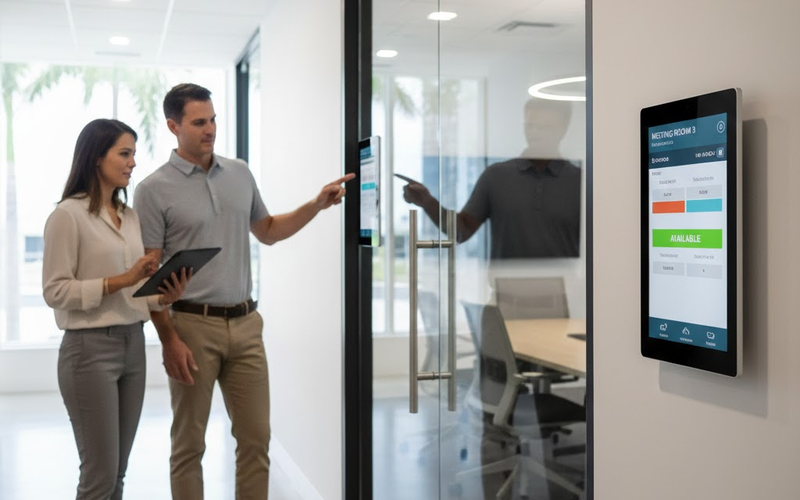
- Meeting and conference rooms: displays, cameras, ceiling or table microphones and a one-touch control panel.
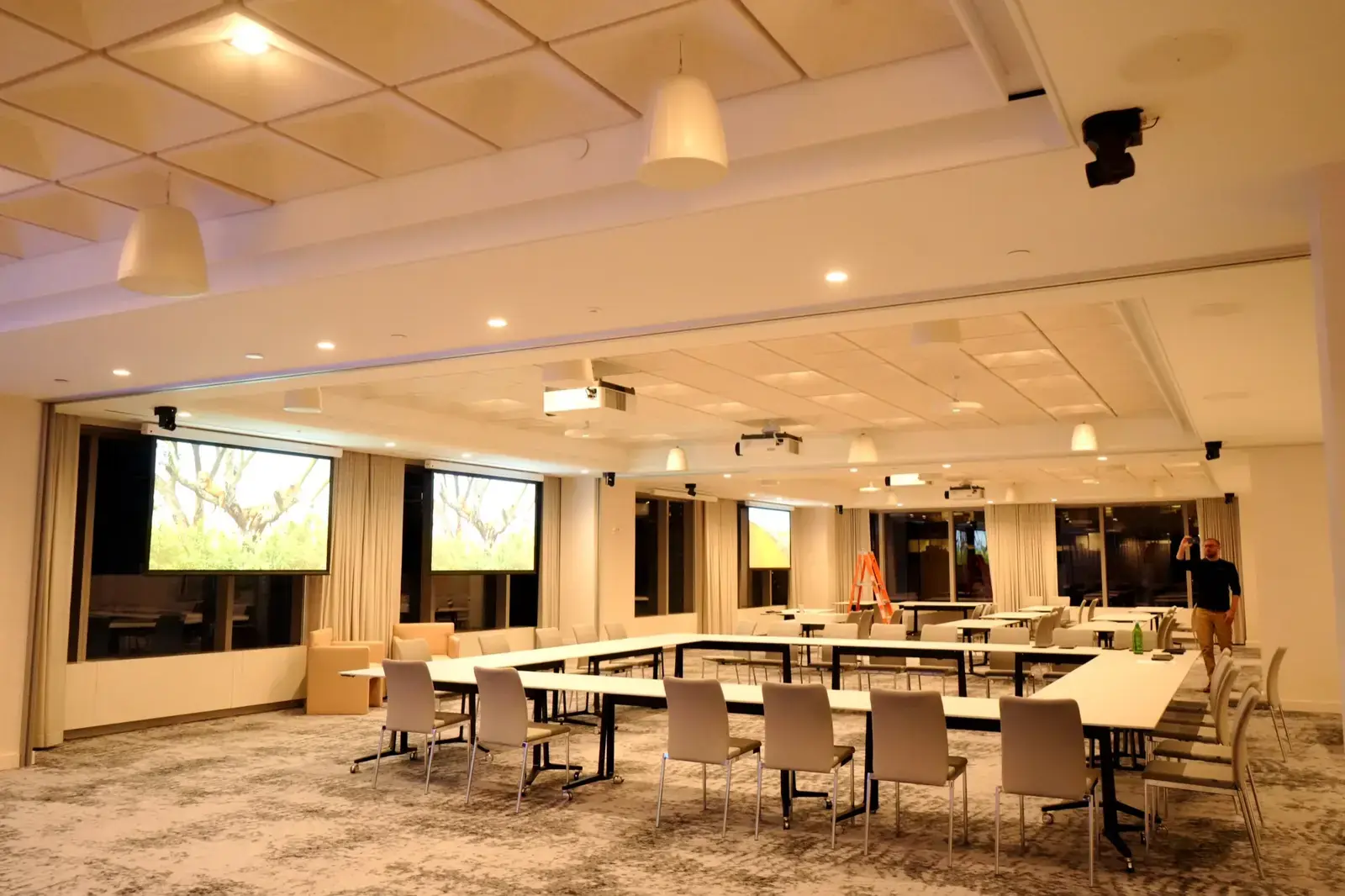
- Boardrooms and training rooms: projection or large-format displays, multiple cameras and room combining.
- Lobbies and public spaces: video walls and digital signage.
- Restaurants, bars and venues: distributed audio, background music zones, displays and lighting control.
- Infrastructure: low-voltage cabling, network drops, racks and power for every device.
What should you look for in an AV company?
Look for proof, not promises. A strong AV company can show certified staff, a contractor license you can verify, real projects similar to yours, written designs before installation and a defined support plan after go-live. If a company cannot show any one of these, keep looking. The cheapest bid often skips the design and support work.
Use this checklist when comparing companies:
- Certified people. AVIXA, the AV industry association, runs the Certified Technology Specialist program. AVIXA describes CTS as the leading professional credential, with specialized CTS-D for design and CTS-I for installation. Ask who on the team holds them.
- A license you can check. Ask for the company's Florida license number and look it up yourself (more on this below).
- Platform experience. If your rooms run Microsoft Teams or Zoom, the company should specify certified hardware and know how to configure it.
- Drawings and a device list. You should see room layouts, a bill of materials and a scope before anyone drills a hole.
- Similar projects. Ask for examples in your type of space: offices, hospitality, retail or venues.
- Support after installation. Ask about response times, remote monitoring and who you call when a room fails at 8:55 a.m.
Does an AV company need a license in Florida?
Florida regulates electrical and alarm system contracting under Chapter 489, Part II of the Florida Statutes, overseen by the Electrical Contractors' Licensing Board. Which license a given AV scope requires depends on the work involved, so ask any AV company for its license number and verify it with the state before work starts.
Chapter 489, Part II covers electrical and alarm system contracting, including certification, registration and the authority of licensed job scope. You can confirm a company's status in minutes on the Florida DBPR license search, which lets anyone search by name or license number.
Permits are a separate question. Many projects that add cabling, power or mounted equipment need them, and requirements differ between Miami-Dade and Broward. We cover that in detail in our guide to AV and low-voltage permits in Miami-Dade and Broward.
What does conference room AV installation include?
A conference room AV installation includes the display or projector, camera, microphones, speakers, a room computer or video bar, a control panel and all the cabling between them. A complete project also covers design, programming, testing and training, so the room works on the first day and keeps working after that.
A well-run project usually follows these steps:
- Site survey. Measure the room, check walls and ceilings, note windows and acoustics, and confirm power and network.
- Design. Choose the platform and equipment, then produce drawings and a device list for approval.
- Infrastructure. Run cabling, add power and prepare backing for mounts, ideally before ceilings and finishes close.
- Installation. Mount displays and cameras, place microphones and speakers, build the rack or credenza.
- Programming and tuning. Configure the meeting platform and control panel, and tune audio for the room.
- Testing and training. Run real calls, fix echo and volume issues, and show staff how to use it.
- Support. Agree on response times, updates and who to call.
For Microsoft Teams rooms, hardware choice matters. Microsoft says its Teams devices certification program ensures certified devices meet a high standard, with higher performance targets for audio, video and the user interface. Specifying certified gear avoids many of the quality problems people blame on the room. Our conference room AV installation service covers Teams and Zoom rooms end to end.
How much does conference room AV installation cost in Miami?
Cost depends on room size, the platform, the quality of audio and cameras, and how much cabling and construction work the space needs. A small huddle room and a large boardroom can differ by an order of magnitude. Any honest AV company will survey the room before quoting a firm price.
We broke down typical price ranges, and what drives them, in our conference room AV installation cost guide for Miami. When comparing quotes, make sure each one includes the same scope: design, cabling, programming, training and support. A low quote that leaves out programming or support usually costs more later.
Why choose a local AV company?
A local AV company can survey your space quickly, knows the permit process in Miami-Dade and Broward, and can send a technician on site when remote support is not enough. For systems your team relies on daily, response time after installation matters as much as the installation itself.
DIST's South Florida office is at 2990 SW 35th Ave in Miami, and our team has delivered complete low-voltage, AV and IT design for local venues. One example is the Paris Theater in Miami Beach, a 25,589-square-foot venue where we delivered 150 voice and data points, 64 security cameras and 25 Wi-Fi access points alongside the AV design.
About the author: Jose Sala is an Audio Engineer and Account Executive at DIST. He works with Miami businesses from the first site visit through design and installation, and specializes in the audio side of conference rooms, restaurants and venues.
Frequently asked questions
What is the difference between an AV integrator and an AV rental company?
An AV integrator designs and permanently installs systems in your building, then supports them for years. An AV rental company supplies and operates equipment for a single event and removes it afterward. For conference rooms, lobbies and venues you use every day, you need an integrator. For a one-off conference or party, rental is the better fit.
How long does a conference room AV installation take?
A single room with ready infrastructure can be installed and programmed in a few days. Projects that need new cabling, power, ceiling work or custom furniture take longer, and multi-room fit-outs follow the construction schedule. Equipment lead times also vary, so start the design early, ideally before walls and ceilings are closed.
Should I choose Microsoft Teams Rooms or Zoom Rooms?
Choose the platform your company already uses for most meetings, because staff will adopt it fastest. Both platforms support certified rooms and can join the other's meetings in many setups. A good AV company will confirm your licensing, recommend certified hardware for that platform and configure it, rather than mixing consumer devices.
Can an AV company install equipment we already bought?
Often, yes, but expect the company to check compatibility first. Consumer displays, webcams or speakers may lack the inputs, mounts, control options or certification a business room needs. A careful integrator will tell you which items can be reused, which will limit the room and what it would cost to work around them.
Do AV companies offer support after installation?
Good ones do, and it should be in writing. Ask for response times, remote monitoring, firmware and software updates, and on-site visits. Without a support plan, small issues like a frozen touch panel or a failed update turn into canceled meetings. Make support part of the comparison, not an afterthought.
What should I prepare before calling an AV company?
List the rooms, how many people use each one, the meeting platform you use and what you want each space to do. Add floor plans or photos if you have them, plus your timeline and budget range. With that, an AV company can give useful advice on the first call and plan an accurate site survey.
Sources
- Certification: CTS, CTS-D and CTS-I (AVIXA) (avixa.org)
- Teams Rooms certified systems and peripherals (Microsoft Learn) (learn.microsoft.com)
- Florida Statutes Chapter 489, Part II: Electrical and Alarm System Contracting (leg.state.fl.us)
- License Search (Florida Department of Business and Professional Regulation) (myfloridalicense.com)